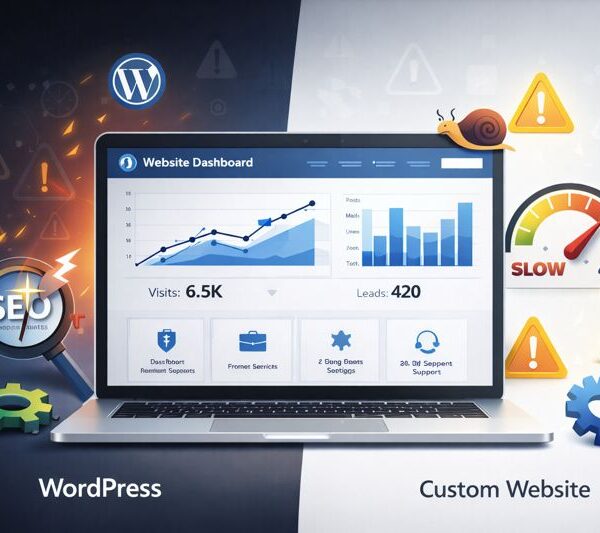




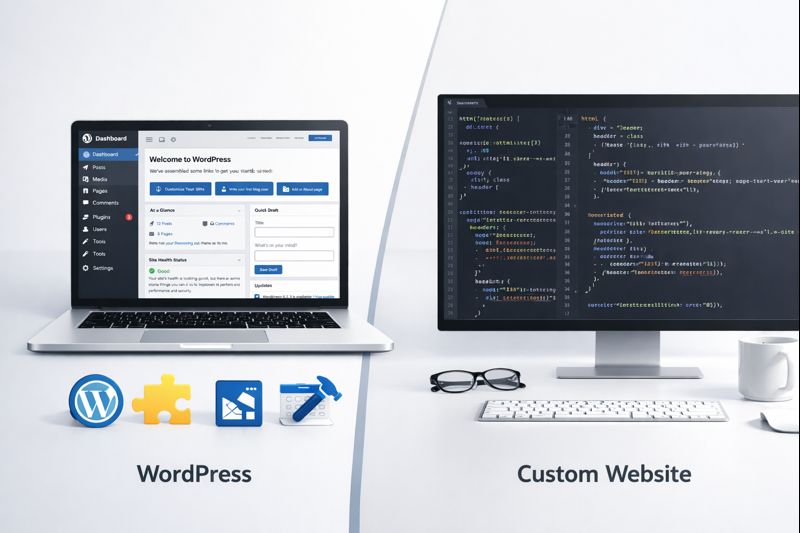

When building a website for your business, one of the most important decisions you will make is choosing the right platform. The most common debate is:
WordPress vs Custom Website — which one is better?
Some businesses prefer WordPress because it is flexible and cost-effective, while others consider custom websites for complete control and uniqueness. Choosing the wrong option can lead to higher costs, maintenance issues, or limited growth.
In this blog, we will compare WordPress vs Custom Website across key factors such as cost, flexibility, SEO, performance, scalability, and maintenance—so you can confidently choose the right solution for your business.
What Is a WordPress Website?
A WordPress website is built using the WordPress Content Management System (CMS). It allows users to manage content, design, and functionality using themes and plugins—often without coding.
WordPress powers more than 43% of all websites, making it the most widely used website platform in the world.
Key Characteristics of WordPress Websites
- Pre-built themes
- Plugin-based functionality
- Easy content management
- SEO-friendly structure
What Is a Custom Website?
A custom website is built from scratch using programming languages like HTML, CSS, JavaScript, and backend technologies such as Node.js, PHP, or Python.
Everything—from design to functionality—is tailored specifically to the business’s needs.
Key Characteristics of Custom Websites
- Fully unique design
- Custom-coded features
- No dependency on CMS
- Requires technical expertise
WordPress vs Custom Website: Detailed Comparison
1. Cost and Budget
WordPress is significantly more affordable. You only pay for hosting, domain, and optional premium themes or plugins.
Custom websites are expensive because they require:
- Design from scratch
- Backend development
- Ongoing developer support
Winner: WordPress (for most businesses)
2. Development Time
WordPress websites can be built in days or weeks.
Custom websites often take months to design, develop, test, and deploy.
Winner: WordPress
3. Ease of Management
With WordPress, non-technical users can:
- Edit content
- Publish blogs
- Update images
Custom websites usually require a developer for even small changes.
Winner: WordPress
4. Design Flexibility
Custom websites offer unlimited design freedom.
WordPress also provides flexibility through custom themes and builders, which is more than enough for most businesses.
Winner: Tie (depends on requirements)
5. SEO Capabilities
WordPress is built with SEO in mind and supports:
- SEO plugins
- Clean URLs
- Blog optimization
- Schema support
Custom websites can be SEO-friendly but require additional development effort.
(Internal link suggestion: Flowmazon SEO Services)
Winner: WordPress
6. Performance and Speed
Custom websites can be extremely fast if built correctly.
WordPress can also be highly optimized with:
- Good hosting
- Lightweight themes
- Performance plugins
Winner: Tie (depends on optimization)
7. Scalability and Growth
WordPress scales well for:
- Business websites
- Blogs
- eCommerce stores
- Membership platforms
Custom websites are better suited for:
- Highly complex applications
- Unique workflows
- Enterprise-level systems
Winner: Depends on business size
8. Maintenance and Support
WordPress maintenance is simple:
- Regular updates
- Plugin management
- Security patches
Custom websites require:
- Dedicated developer support
- Manual updates
- Higher maintenance cost
Winner: WordPress
When Should You Choose WordPress?
Choose WordPress if you want:
- Faster launch
- Lower cost
- Easy content updates
- SEO-friendly structure
- Proven scalability
This is why agencies like Flowmazon recommend WordPress for most business websites.
(Internal link suggestion: Flowmazon Website Development Services)
When Should You Choose a Custom Website?
A custom website is suitable if:
- You need highly specific functionality
- Your project is application-based
- You have a large budget and dev team
Custom websites are ideal for complex platforms—not standard business sites.
WordPress vs Custom Website: Final Verdict
For 90% of businesses, WordPress is the smarter choice.
It offers:
- Speed
- Affordability
- SEO power
- Ease of use
- Long-term growth
Custom websites are powerful—but only when truly needed.
Conclusion
Choosing between WordPress and a custom website depends on your business goals—not hype.
If you want a professional, scalable, SEO-friendly website without high costs, WordPress is the clear winner.
Custom websites should only be chosen when business requirements demand it.